



Endothelin Receptor
Endothelin receptors are G protein-coupled receptors (GPCRs) of the β-group of rhodopsin receptors that bind to endothelin ligands, which are 21 amino acid long peptides derived from longer prepro-endothelin precursors. There are at least four types known, ETA, ETB (ETB1, ETB2) and ETC. The ETA receptor is characterized by having high affinity and selectivity for ET-1 and ET-2 compared to ET-3, whereas the ETB receptor has equivalent high affinity for all three endothelin isopeptides.
Endothelins are synthesized in several tissues, including the vascular endothelium (ET-1 exclusively) and smooth muscle cells. Released endothelin binds to the endothelin receptors ETA and ETB, the ETA receptors on vascular smooth muscle cells mediating vasoconstriction, and the ETB receptors on the endothelium linked to nitric oxide (NO) and prostacyclin release.
Endothelin Receptor Isoform Specific Products
All Product Categories
-
Endothelin Receptor Inhibitors
(18)
View all products
-
Endothelin Receptor Agonists
(14)
View all products
-
Endothelin Receptor Antagonists
(94)
View all products
-
Endothelin Receptor Activators
(2)
View all products
-
Endothelin Receptor Modulator
(1)
View all products
-
Endothelin Receptor Control
(1)
View all products
-
Endothelin Receptor Ligands
(3)
View all products
-
Endothelin Receptor Proteins
(7)
View all products
-
Endothelin Receptor Type A (EDNRA) Proteins
(3)
View all products
-
Endothelin R Type B (EDNRB) Proteins
(4)
View all products
-
Endothelin Receptor Related Products (152)
Related Products (152)

-
Recombinant Proteins (7)
-
Antibodies (1)
-
Endothelin Receptor Isoform Comparison
-
[Asn18] Endothelin-1 (swine, human)
![[Asn18] Endothelin-1 (swine, human)](https://file.medchemexpress.com/product_pic/hy-p3615.gif "Click to View [Asn18] Endothelin-1 (swine, human) Product Detail") 0 ImagesCat. No.: HY-P3615CAS No.: 138716-98-0[Asn18] Endothelin-1 swine, human is a structural analogue of Endothelin 1 (swine, human) (HY-P0202), with the Asp amino acid at position 18 mutated to Asn. Endothelin 1 (swine, human) is a synthetic peptide with human and porcine endothelin 1 sequences and is a potent endogenous vasoconstrictor.
0 ImagesCat. No.: HY-P3615CAS No.: 138716-98-0[Asn18] Endothelin-1 swine, human is a structural analogue of Endothelin 1 (swine, human) (HY-P0202), with the Asp amino acid at position 18 mutated to Asn. Endothelin 1 (swine, human) is a synthetic peptide with human and porcine endothelin 1 sequences and is a potent endogenous vasoconstrictor.
-
Clazosentan (Standard)
 0 ImagesSynonyms: Ro 61-1790 (Standard); VML 588 (Standard); AXV-034343 (Standard)Clazosentan (Standard) is the analytical standard of Clazosentan. This product is intended for research and analytical applications. Clazosentan (Ro 61-1790) is a selective endothelin A (ETA) receptor antagonist. Clazosentan inhibits ET-1-mediated vasoconstriction. Clazosentan prevents cerebral vasospasm, vasospasm-related cerebral infarction.
-
CH-141
 0 ImagesCat. No.: HY-126036CAS No.: 78279-88-6CH-141 is a peripheral vasodilator, that can be used in hypertension research.
-
Ambrisentan (Standard)
 0 ImagesSynonyms: BSF 208075 (Standard); LU 208075 (Standard)Ambrisentan (Standard) is the analytical standard of Ambrisentan. This product is intended for research and analytical applications. Ambrisentan is a selective ET type A receptor (ETAR) antagonist.
-
A-127722
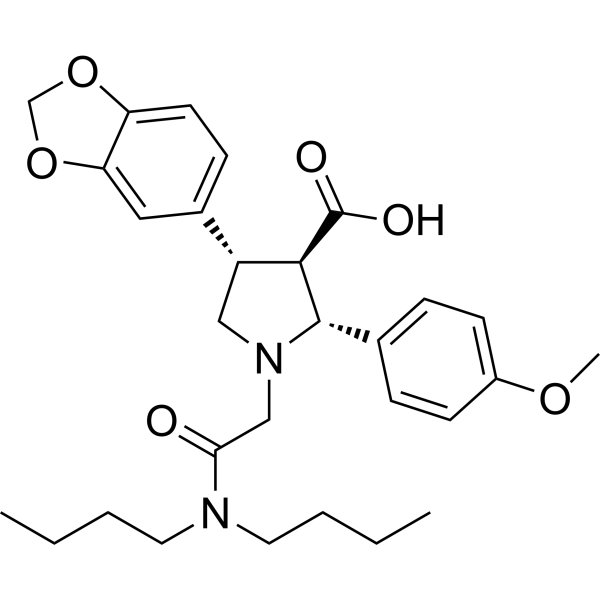 0 ImagesCat. No.: HY-114674CAS No.: 195704-72-4A-127722 is A 2, 4-dialarylpyrrolidine-3-carboxylic acid ETA selective endothelin receptor (ET receptor) antagonist with IC50 value of 0.36 nM.
-
L-749329
 0 ImagesCat. No.: HY-117644CAS No.: 159590-37-1Synonyms: (Rac)-L-754142L-749329 ((Rac)-L-754142) is an ETA and ETB receptor antagonist, with Kis of 0.062 nM and 2.25 nM for ETA and ETB respectively. L-749329 inhibits ET-1-stimulated signaling.
-
Piperitenone oxide
 0 ImagesPiperitenone oxide is an orally active monoterpene ketone. Piperitenone oxide can be isolated from the essential oils of plants belonging to Mentha x villosa and Ziziphora clinopodioides. Piperitenone oxide induces differentiation. Piperitenone oxide induces chromosome breakage damage, aneuploidy damage and DNA single-strand breaks. Piperitenone oxide reduces ET-1 levels. Piperitenone oxide exerts antihypertensive effects. Piperitenone oxide can be used in studies related to colon cancer.
-
Sulfisoxazole (Standard)
 0 ImagesSulfisoxazole (Standard) is the analytical standard of Sulfisoxazole. This product is intended for research and analytical applications. Sulfisoxazole (Sulfafurazole) is an orally active endothelin receptor antagonist with IC50 values of 0.60 μM and 22 μM against endothelin receptor A and endothelin receptor B, respectively. Sulfisoxazole is a sulfonamide antibacterial agent with an oxazole substituent. Sulfisoxazole inhibits breast cancer exosome release by targeting endothelin receptor A.
-
Zibotentan (Standard)
 0 ImagesSynonyms: ZD4054 (Standard)Zibotentan (Standard) is the analytical standard of Zibotentan. This product is intended for research and analytical applications. Zibotentan (ZD4054) is a potent, selective and orally active endothelin A (ETA) receptor antagonist with a Ki of 13 nM. Zibotentan has no inhibitory effect on ETB. Zibotentan has anticancer effects and can be used for castration-resistant prostate cancer (CRPC) research.
-
Atrasentan sodium
 0 ImagesCat. No.: HY-114674ACAS No.: 178738-96-0Atrasentan sodium is an endothelin receptor antagonist with IC50 of 0.0551 nM for ETA.
-
IRL 2500 (Standard)
 0 ImagesCat. No.: HY-103460RCAS No.: 169545-27-1IRL 2500 (Standard) is the analytical standard of IRL 2500 (HY-103460). This product is intended for research and analytical applications. IRL 2500 is a potent Endothelin receptor antagonist. IRL 2500 shows IC50 values of 1.3 and 94 nM for ETB and ETA receptors, respectively. IRL 2500 inhibits ETB receptor-mediated blood pressure increase and renal vascular resistance in rats in vivo.
-
Sitaxsentan-13C6
 0 ImagesCat. No.: HY-76520SSynonyms: IPI 1040-13C6 ; TBC-11251-13C6Sitaxsentan-13C6 (IPI 1040-13C6) is 13C labeled Sitaxsentan (HY-76520). Sitaxsentan (IPI 1040 sodium; TBC11251 sodium) is a potent, selective and orally active endothelin A receptor (ETA) antagonist with an IC50 of 1.4 nM and a Ki of 0.43 nM. Sitaxsentan exhibits an IC50 for the ETB receptor of as high as 9800 nM. Sitaxsentan is metabolized by CYP2C9 and CYP3A4, normalizes shunt-induced endothelial abnormalities, restores BMPR signaling, and suppresses pulmonary vascular remodeling and hemodynamic deterioration. Sitaxsentan can be applied in the research of pulmonary arterial hypertension and portopulmonary hypertension.
-
BMS 182874 (Standard)
 0 ImagesCat. No.: HY-118497RCAS No.: 153042-42-3BMS 182874 (Standard) is the analytical standard of BMS 182874. This product is intended for research and analytical applications. BMS 182874 is an orallyactive, highly selective endothelin receptor (ETA receptor) antagonist, with IC50 value of 0.150 μM, Ki of 0.055 μM. BMS 182874 reduces the arterial pressure of Deoxycorticosterone acetate (HY-B1472) induced hypertension model in rats, and can be used for cardiovascular disease research.
-
FR139317
 0 ImagesCat. No.: HY-102092CAS No.: 142375-60-8Synonyms: PD 147953FR139317 (PD 147953) is a selective ETA receptor antagonist. FR139317 inhibits cerebral activation by intraventricular endothelin-1 in conscious rats. FR139317 also ameliorates cerebral vasospasm in dogs.
-
WS009B
 0 ImagesCat. No.: HY-117634CAS No.: 136286-50-5WS009B is a selective endothelin receptor antagonist (ET-1: IC50=0.67 μM; ET-2: IC50=0.8 μM). WS009B can be used in the study of cardiovascular diseases.
-
ATZ-1993
 0 ImagesCat. No.: HY-122237CAS No.: 219705-77-8ATZ-1993 is an orally active, nonpeptide endothelin receptor subtype Aand endothelin receptor subtype B antagonist with pKi values of 8.69, 7.20, respectively. ATZ-1993 has the potential for the research of intimal hyperplasia after balloon denudation of the carotid artery.
-
AT1R antagonist 4
 0 ImagesCat. No.: HY-180443CAS No.: 2982582-16-9AT1R antagonist 4 (Example 26) is an AT1R antagonist. AT1R antagonist 4 shows excellent antagonistic activity against calcium influx in cells stably expressing AT1 receptors and ETA receptors. AT1R antagonist 4 can be used in kidney disease research.
-
BMS 182874 hydrochloride
 0 ImagesCat. No.: HY-103458CAS No.: 1215703-04-0BMS 182874 hydrochloride is an orallyactive, highly selective endothelin receptor (ETA receptor) antagonist, with IC50 value of 0.150 μM, Ki of 0.055 μM. BMS 182874 hydrochloride reduces the arterial pressure of Deoxycorticosterone acetate (HY-B1472) induced hypertension model in rats, and can be used for cardiovascular disease research.
-
Sitaxsentan sodium (Standard)
 0 ImagesSynonyms: IPI 1040 sodium (Standard); TBC11251 sodium (Standard)Sitaxsentan (sodium) (Standard) is the analytical standard of Sitaxsentan sodium (IPI 1040 sodium; TBC11251 sodium) (HY-11103). This product is intended for research and analytical applications. Sitaxsentan sodium is a potent, selective and orally active endothelin A receptor (ETA) antagonist with an IC50 of 1.4 nM and a Ki of 0.43 nM. Sitaxsentan sodium exhibits an IC50 for the ETB receptor of as high as 9800 nM. Sitaxsentan sodium is metabolized by CYP2C9 and CYP3A4, normalizes shunt-induced endothelial abnormalities, restores BMPR signaling, and suppresses pulmonary vascular remodeling and hemodynamic deterioration. Sitaxsentan sodium can be applied in the research of pulmonary arterial hypertension and portopulmonary hypertension.
-
IRL 1038
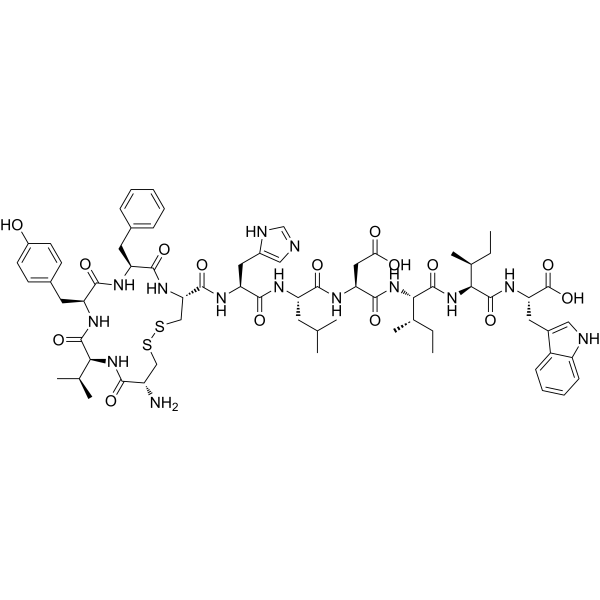 0 ImagesCat. No.: HY-P1018CAS No.: 144602-02-8IRL 1038 is an endothelin B receptor selective antagonist with a Ki of 6-11 nM.




